About “The Roots of Coincidence”
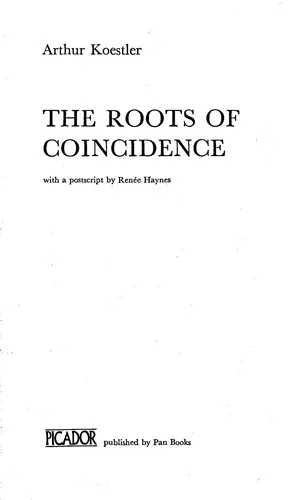
The Roots of Coincidence is a 1972 book by Arthur Koestler that explores theories of parapsychology, including extrasensory perception and psychokinesis. Koestler examines connections between modern physics, time, and paranormal phenomena, drawing on Carl Jung's concept of synchronicity and the seriality theory of Paul Kammerer. He argues that science should take paranormal phenomena seriously and study them with both rigorous experimentation and a sense of wonder. He concludes that such events are rare and unpredictable and require a combination of scientific skill and curiosity to observe and record. The book was criticized by psychologist David Marks, who called it pseudoscience and accused Koestler of uncritically accepting ESP experiments while ignoring contradictory evidence. Marks introduced the term "Koestler's Fallacy" to describe the assumption that unusual coincidences cannot happen by chance. John Beloff gave a mixed review, calling the book a typical Koestlerian work but noting inaccuracies in its claims about psychical research.
Book details
- Published
- 1973
- Latest edition
- 1973 · ISBN 0394719344
View more editions (4)
| Cover | Edition | Year | ISBN | |
|---|---|---|---|---|
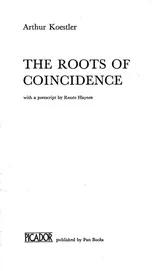 | The roots of coincidence | 1973 | 0394719344 | Buy on Amazon |
 | The Roots of Coincidence | 1972 | 9780394480381 | Buy on Amazon |
 | The roots of coincidence | 1972 | — | Buy on Amazon |
 | The roots of coincidence | 1972 | 0091102804 | Buy on Amazon |
Frequently asked questions
How many pages is The Roots of Coincidence?
The Roots of Coincidence by Arthur Koestler has 158 pages.