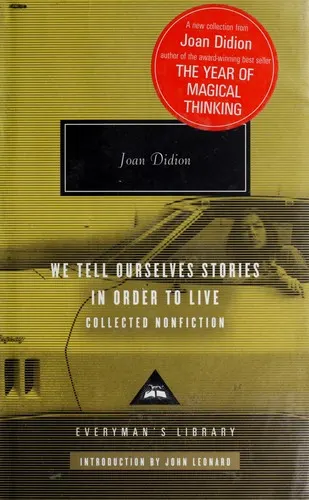
About “We Tell Ourselves Stories in Order to Live”
"Slouching Towards Bethlehem" captures the counterculture of the 1960s, focusing on California and figures like Joan Baez and the Haight-Ashbury scene. "The White Album" explores the political turbulence of the late 1960s and early 1970s, including the Manson family, the Black Panthers, and Hollywood. "Salvador" examines the social and political conditions during a civil war. "Miami" reveals the city's role in the Cold War, from the Bay of Pigs to Watergate. "After Henry" covers events like the Reagans, Patty Hearst, and the Central Park jogger case. "Political Fictions" analyzes modern political issues, including censorship and figures like Gingrich and Clinton. "Where I Was From" challenges the myth of California as a land of opportunity.
Praise for “We Tell Ourselves Stories in Order to Live”
“[Didion’s is] one of the most recognizable—and brilliant—literary styles to emerge in America during the past four decades...[She is] a great American writer.”
“One beautiful sentence follows another.... Didion has remained a clearheaded and original writer all her long life.”
“Her intelligence is as honed as ever.... Her vision is ice-water clear.... Didion has captured the mood of America.”
Book details
- First published
- 2006
- Latest edition
- 2006 · ISBN 9780307264879
- Pages
- 1122
View more editions (2)
| Cover | Edition | Year | ISBN | |
|---|---|---|---|---|
 | We Tell Ourselves Stories in Order to Live | 2006 | 9780307264879 | Buy on Amazon |
 | We Tell Ourselves Stories in Order to Live | 2006 | 9780307264879 | Buy on Amazon |
Frequently asked questions
How many pages is We Tell Ourselves Stories in Order to Live?
We Tell Ourselves Stories in Order to Live by Joan Didion has 1122 pages.
More series like Everyman's Library


Book descriptions, author biographies, award records and review quotes on this page are courtesy of Penguin Random House.