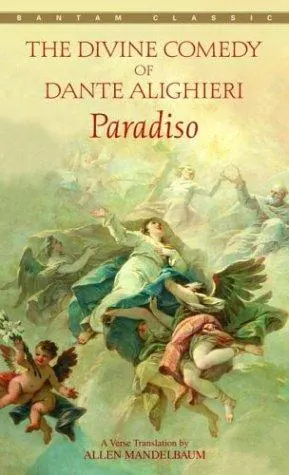
About “Paradiso”
Paradiso is the third and final part of Dante Alighieri's Divine Comedy, following Inferno and Purgatorio. It describes Dante's journey through Heaven, guided by Beatrice, who represents Christian grace or revelation. The poem portrays Paradise as a series of concentric spheres surrounding the Earth, including the Moon, Mercury, Venus, the Sun, Mars, Jupiter, Saturn, the Fixed Stars, the Primum Mobile, and the Empyrean. Written in the early 14th century, Paradiso serves as an allegory for the soul's ascent to God. (Summary adapted from Wikipedia, CC BY-SA 4.0.)
Praise for “Paradiso”
“The English Dante of choice.”
“Exactly what we have waited for these years, a Dante with clarity, eloquence, terror, and profoundly moving depths.”
“Tough and supple, tender and violent . . . vigorous, vernacular . . . Mandelbaum's Dante will stand high among modern translations.”
Book details
- Latest edition
- 1986 · ISBN 9780553212044
- ISBN
- 9780553212044
Frequently asked questions
How many pages is Paradiso?
Paradiso by Dante Alighieri has 429 pages.
More by Dante Alighieri


Some summaries adapted from Wikipedia, CC BY-SA 4.0. Book descriptions, author biographies, award records and review quotes on this page are courtesy of Penguin Random House.